

Published :
Updated :
 For all latest news, follow The Financial Express Google News channel.
The scheduled banks' sub-branch banking model has emerged as a powerhouse for financial inclusion in the final quarter of 2025, with credit disbursement skyrocketing by 17.4 per cent - nearly nine times the growth rate of the overall banking sector.
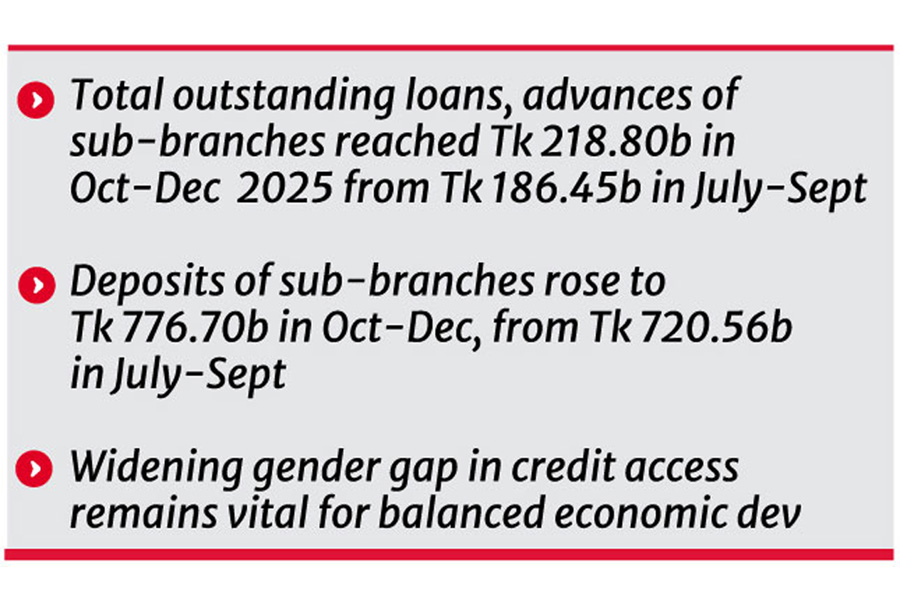
The Bangladesh Bank's (BB) latest data for the October-December 2025 period reveals a surge in niche banking activities, as the total outstanding loans and advances disbursed through these sub-branches reached Tk 218.80 billion in the period from Tk 186.45 billion in July-September 2025.
By comparison, the overall banking sector's loan growth during the Oct-Dec period was only 2.0 per cent, as per the BB data.
This aggressive expansion in lending was mirrored by a robust 7.8 per cent growth in deposits, which climbed to Tk 776.70 billion in October-December, comfortably outperforming the broader industry's 3.4 per cent deposit increase. Deposits collected via the sub-branches amounted to Tk 720.56 billion in the July-September 2025 quarter.
As the network expanded to 4,971 units - with a strategic push into rural territories - sub-branches are increasingly bridging the gap between the traditional hubs and the unbanked.
While the model successfully drew in over 8.0 million deposit accounts, analysts point to a lingering challenge: ensuring that the credit boom translates into more equitable access for women borrowers to achieve a truly inclusive growth.
The geographical and institutional expansion of this model has been significant, as the total number of sub-branches rose to 4,971 by the end of December 2025 from 4,885 in September.
This growth was fuelled by the inauguration of 56 rural and 30 urban sub-branches, pushing the rural share of the network to 49.3 per cent.
The quarter under review also saw notable institutional shifts, with Janata Bank PLC and Modhumoti Bank PLC officially commencing their sub-branch operations.
In terms of market leadership, IFIC Bank PLC continues to dominate the landscape with 1,225 units, followed by NRBC Bank PLC with 693, and Dutch-Bangla Bank PLC with 334.
From a regional perspective, Dhaka district maintains the highest concentration with 998 sub-branches, while Chattogram and Cumilla follow with 460 and 216 units, respectively.
The surge in deposit mobilisation has further solidified the role of sub-branches, as their share of the total banking sector deposits edged up to 3.7 per cent from 3.5 per cent. Rural deposits also saw an upward trend, reaching 32.3 per cent of the total sub-branch pool.
Encouragingly, women's participation in the savings ecosystem grew, with the total number of deposit accounts expanding by 11.7 per cent to 8.05 million and the share of female account-holders rising to 37.5 per cent.
However, the credit side of the ledger tells a different story. While the total loan accounts grew by 8.8 per cent to 240,411, the share of women borrowers marginally declined to 14.4 per cent.
Analysts emphasise that while the sub-branch model is successfully penetrating the rural markets, addressing this widening gender gap in credit access remains vital for balanced economic development.
Dr. Masrur Reaz, Chairman of Policy Exchange Bangladesh, said the continued expansion of the scheduled banks' sub-branches is a promising development for financial inclusion in Bangladesh.
These nimble banking units are significantly outperforming the broader banking sector, both in mobilising deposits and disbursing loans, particularly in the rural areas.
The growth in women's deposit accounts is encouraging, but the slower rise in women's access to loans highlights the need for targeted measures to ensure a truly inclusive financial growth, he also said.
Expanding sub-branches strategically across the under-served regions, coupled with tailored financial products for women, could accelerate equitable economic participation across the country, he suggested.
sajibur@gmail.com