


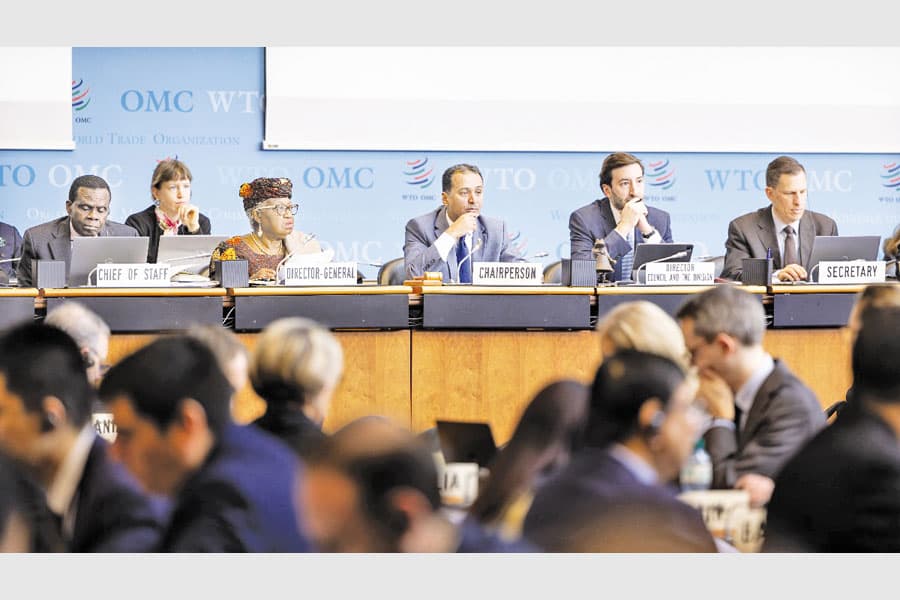


If everything goes smoothly, within two weeks, trade ministers and negotiators from more than 160 countries will meet in Yaoundé, Cameroon, to reach deals on the multilateral trading system. It will be the 14th ministerial conference (MC14) of the World Trade Organization (WTO), the global trade rule-making and dispute-resolving body. Several agendas are already on the table, and negotiators will try to reach agreements through consensus during the four-day sessions on March 26-29, 2026.


MC14 will take place during a turbulent geopolitical period, as the world is witnessing a devastating war in the Middle East. The United States and Israel started a joint invasion of Iran two weeks ago, triggering a war that has already shocked the global economy and trade. There is concern that if the war continues, the duration of MC14 may be shortened, adjourned, or deferred. As the ministerial conference is the WTO's highest decision-making forum, adjournment creates uncertainty about the issues under negotiation.
WTO reform, modern industrial policy, electronic commerce governance, investment facilitation, fisheries subsidies, farm subsidies, and trade-related climate measures are the key areas of discussion and negotiation at MC14. A few other issues, such as the Least Developed Countries (LDCs) issue, will also be on the table. Previous ministerial meetings show that consensus may be reached on only a few issues, and even then, only to a limited extent, resulting in a lower level of binding commitment.
Over the years, discussions and debates on WTO reforms have intensified, mainly because the organisation has delivered limited rule-based trade liberalisation in a balanced way. Some argue that the current WTO structure is rigid, making it difficult to reach consensus on any issue. That is why talks on disciplining farm subsidies in global trade remain unresolved after two decades. Others argue that the single undertaking principle, nothing agreed until everything is agreed, is a major barrier to effective deals. The failure of the Doha round of negotiation, initiated in 2001 at MC4 in the Qatari capital, is the best example. Some believe there are still ways to bypass these rigidities by reaching consensus in some areas. For example, the Trade Facilitation Agreement (TFA) was approved at MC9 in Bali, although key issues of the Doha Round talks remained unresolved. Against this backdrop, WTO reform talks have also become controversial, although most support reform.
Hinrich Foundation, an Asia-based philanthropic organisation that works on global trade, conducted a comprehensive survey on WTO reform last year. The survey findings showed that around half of the more than 27,000 respondents strongly and around 30 per cent moderately agreed on the necessity of WTO reform. Again, more than 90 per cent think it is necessary to modernise the current consensus-based decision-making system at the WTO. These respondents are also in favour of adopting flexible approaches to legally recognise trade rules reached by a smaller group of members, without requiring unanimous agreement from all WTO members. In other words, most stakeholders now think the plurilateral approach to trade negotiations should be advanced to avoid gridlock in consensus-based multilateral deals.
A number of WTO members are now turning to open plurilateral agreements and joint statement initiatives to advance their interests. Under the plurilateral framework, a few members start negotiations on an issue, and when they reach consensus, a deal is signed. The deal is then kept open for other WTO members to join on negotiated terms and conditions. It applies only to those who negotiated or joined. Finally, the deal becomes part of the WTO agreements if adopted in a ministerial conference. At MC14, the Investment Facilitation Agreement (IFA) will be on the table for inclusion in the WTO rulebook. Despite intense efforts, it was not endorsed at MC13 in Abu Dhabi in 2024 due to resistance from several developing countries, including India and South Africa. Currently, 128 WTO members back the deal.
Similarly, more than 70 members of the WTO are pushing for an e-commerce plurilateral deal as a JSI to be incorporated into the rulebook, making it part of the multilateral trade rules. It is, however, unlikely to get the endorsement in the MC14, although more members will support the deal. Since 1998, the moratorium on customs duties on electronic transmissions has been renewed at every ministerial conference. The process, however, always faced difficulties, as some members sought a permanent decision rather than a temporary extension. In the upcoming ministerial, it will again face heated controversy among the members. Those who are in favour of a moratorium argue that imposing tariffs on electronic transmissions would raise costs for consumers and businesses. Opponents of the moratorium say that, despite the rapid expansion of digital trade, countries are now deprived of significant revenue because no customs duties apply to digital trade.
MC14 will also face tension over implementing the remaining fisheries subsidies agreement. The first part, known as Fish-1, was adopted in 2022 and asked WTO members to ban subsidies for illegal, unreported, and unregulated fishing; for fishing on overfished stocks when no rebuilding measures are in place; and for unregulated fishing on the high seas. Now, Fish-2 calls for restricting subsidies to overcapacity in fishing fleets and to overfishing, not just in specific situations. The goal is to stop subsidies from driving fleets beyond sustainable limits. Some progress is expected at MC14, although a deal on Fish-2 is unlikely, as members have three more years under the so-called 'sunset clause'.
At MC14, negotiations on agriculture will focus on three areas: domestic support, public stockholding for food security by developing countries at administered prices, and market access for agricultural products. A draft text of the Declaration on Agriculture, Trade and Global Food Security has already been developed, and members are working on it.
For Bangladesh, MC14 will be the last ministerial conference as a Least Developed Country (LDC), as the country is set to lose the LDC tag in November this year, along with Nepal and Laos. Bangladesh has formally requested the UN for a three-year extension of the scheduled graduation date, and the decision will be announced in a few months.
For the last couple of years, Bangladesh and some other LDCs have been pursuing a decision to extend LDC privileges to graduating LDCs. At MC14, the same demand will be pushed, although the chances of endorsement are slim. It will also be more challenging for the country and other LDCs to take positions on key agendas, such as WTO reforms and plurilateral initiatives. A policy brief, jointly released by the Centre for Policy Dialogue (CPD) and Friedrich-Ebert-Stiftung (FES) Bangladesh last month, argued that Bangladesh should be proactively involved in all discussions on WTO reforms, including the MFN principle, single undertaking, and level playing field to secure the country's interest as a graduating LDC. It also suggested that the country should not support the plurilateralisation of the WTO. As the new government has just taken responsibility, it is important to see how actively the country can participate in MC14.