


The current fiscal year is an election year, with polls scheduled for February 12. A key question is how the economy will respond to the election in terms of Gross Domestic Product (GDP) growth. As the economy has entered the Political Business Cycle (PBC), the impact of this cycle on growth needs review.
Since William Nordhaus introduced the PBC concept in 1975, many economists have reviewed and extended the theory in various contexts. Simply put, political business cycles are cycles in macroeconomic variables such as output, unemployment, and inflation, induced by the electoral cycle. The impacts of elections on GDP growth, the job market, and price stability are reflected in the PBC. Two major models of the PBC have emerged: the opportunistic and the partisan.
In Bangladesh, the discussion of the political business cycle first emerged more than a decade ago, before the 12th national elections in 2024. An analysis titled 'Bangladesh Economy in FY2014: Three Months after the Budget, Three Months before the Elections', prepared and released by the Centre for Policy Dialogue (CPD) in October 2013, also discussed in detail the prevalence of the political business cycle in Bangladesh. It said: "A large number of countries around the world experience the impact of the political business cycle on GDP growth. Bangladesh has also witnessed a fall in real GDP growth during the election years. This is also because Bangladesh tends to experience significant violence during periods of political transition."
Dr Zaihd Hussain, the then-lead economist of the World Bank in Bangladesh, also explained the topic in an analytical note titled 'Economic growth and elections in Bangladesh' in 2013. He showed that almost every election followed a period of political impasse over how the poll would be held. So, every election year during the period under review was marked by uncertainty regarding the holding of elections and the peaceful transfer of power, street agitation, strikes and violence. All these disruptions ultimately reduce economic growth in election years. So, GDP growth also declined in FY96, FY01 and FY09. The economist, however, added that the 2009 election was not preceded by strikes or violence, which showed a 'perverse relation between election and growth.'
Around 13 years later, many things have changed in the country. The extent to which political business cycles prevail and their impact requires in-depth research. What is clear is that GDP growth usually declines in election years, or more precisely, in fiscal years with elections.
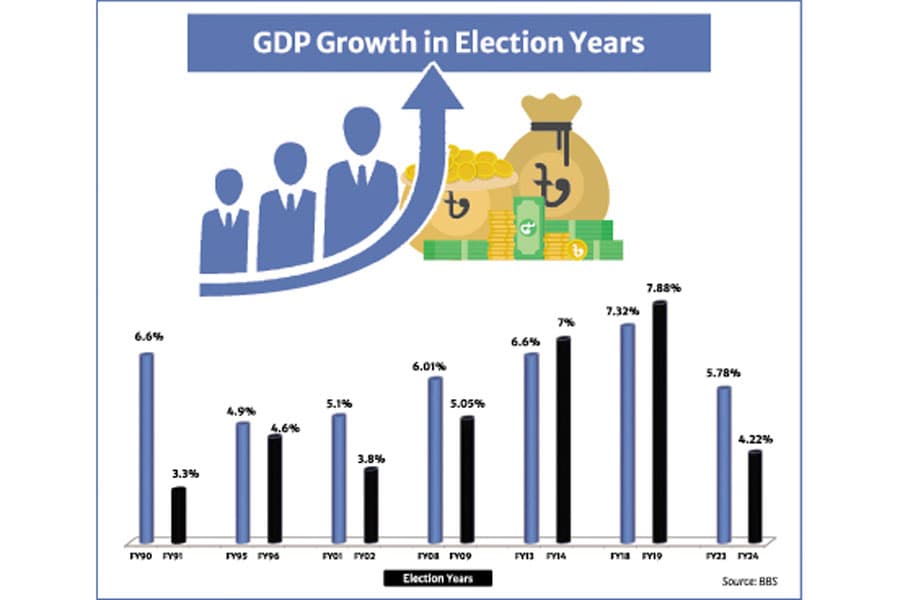
Over the last three and a half decades, Bangladesh has held nine general elections. GDP growth in election years decreased on five occasions and increased on two. Since the 6th and 7th national polls were held within four months and in the same fiscal year (FY96), these polls are counted once for growth analysis.
It is notable that the last three elections in Bangladesh were highly contentious due to massive irregularities and manipulations by the Hasina-led authoritarian governments. Instead of ensuring level playing fields for all the political parties, the tyrant Hasina unleashed a reign of terror and fear, marginalising the dissenting voices. In this process, she had ensured her stay in power in the name of being 're-elected in popular votes.'
Statistics showed that GDP growth consistently declined in the four election years until 2009. The declines in FY91 and FY96 were largely driven by political conflicts and pre-poll violence. This was not the case in FY01, when the country saw less violence. The decline in FY09 followed pre-poll uncertainties under the army-backed caretaker governments. Still, the common trend was a decline in growth during election years.
The rate of GDP growth increased in FY14 and FY19 to 7.00 per cent and 7.88 per cent respectively, following the 10th and 11th national polls. These two elections were controversial, as mentioned earlier. Since both elections were held in the middle of the fiscal years, one may argue that they reduced due to uncertainty about power transfer before the fiscal years ended.
The 12th national election was also widely disputed, which re-elected Hasina for the fifth time as prime minister and for the fourth time in a row. Things, however, changed significantly within seven months of since her re-election. Student-led mass uprising forced the tyrant to step down, leave the country and take shelter in New Delhi on August 5 2024. Before that, the repressive regime killed at least 1,400 people and injured some 20,000, making the uprising bloody.
The Yunus-led interim government took charge three days later and began work to restore normalcy. The disruption of economic activities during the month-long mass uprising continued for several months. This led to a further decline in GDP growth, to 3.97 per cent in FY25 from 4.22 per cent in FY24. As FY24 was an election year, it also saw a decline in growth from FY23, when GDP expanded at 5.78 per cent.
Projections indicate that GDP growth will increase modestly in the current fiscal year (FY26), which is also an election year, compared with FY25. If this happens, it will be the third time in the last three and a half decades that growth exceeded the previous year's rate. Since the election is taking place in an environment where a major political party is barred from competing due to its decade-long misdeeds in power, the situation remains fluid.
In fact, the upcoming election will be held at a critical juncture in Bangladesh's history to restore democratic transition. The economy's response in the post-election period will largely depend on the quality of the election.