

Published :
Updated :
 For all latest news, follow The Financial Express Google News channel.
Bangladesh arguably is one of the most climate vulnerable country in the world. The government is well aware of the need to integrate climate change considerations in the national development process. Several climate change strategies have been developed, and climate change factors are increasingly being integrated with national development strategies. Bangladesh is also a strong player in the international fora in influencing the global climate change decisions. It has provided its own nationally determined contribution (NDC) commitments to help reduce greenhouse gas emissions (GHG) required to achieve global climate goals, even though Bangladesh is a small contributor to these emissions.
To implement climate strategies and associated goals and targets, Bangladesh has made notable progress with developing policies and regulations, providing climate finance from own resources and establishing climate change institutions. The government's efforts are complemented by a vibrant non-government (NGO) sector that is active both nationally and internationally.
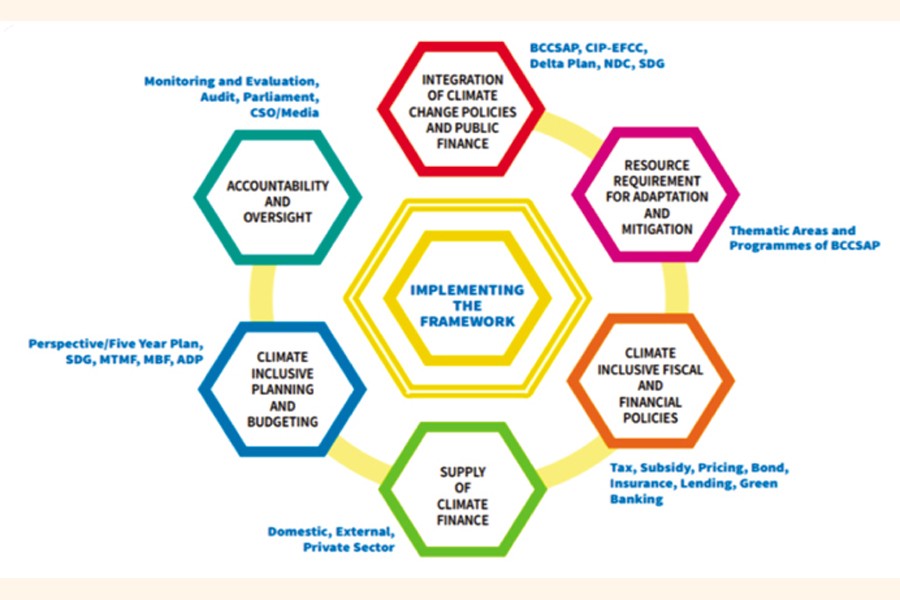
A particularly notable institutional progress was the adoption of the Climate Fiscal Framework (CFF) in 2014 that was updated in 2020. But unfortunately, the core elements of a proper climate fiscal framework are yet to be implemented. While the revised CFF 2020 recognised the importance of integrating climate change considerations in resource allocation strategy, in practice very little has been done. It similarly notes the significant role that climate sensitive taxes, subsidies and pricing policies can play in resource mobilization as well as in providing incentives to private sector for adopting climate sensitive technologies and avoiding pollution behaviour. Yet very little implementation progress has been made in these areas.
While there is some effort to integrate climate change concerns in expenditure allocation, the integration is done somewhat mechanically as an accounting framework. It is not clear how the identified level of climate financing from the budget, estimated between 7-9 per cent of total public spending, relates to the goals of the NDC, the Bangladesh Climate Change Strategy and Action Plan (BCCSAP) or the national development plans. This disconnect between climate expenditure, strategies and outcomes is a major weakness of the present approach to integration of climate change in national development.
The costing of major climate change programs such as the NDC, the Bangladesh Delta Plan and the Bangladesh Country Investment Plan for Environment, Forestry and Climate (CIP- EFCC) and their implications for annual budget allocations and financing options have not been worked out. Indicative estimates suggest that properly implementing these three programs alone could require 5-6 per cent of GDP annually, which substantially exceeds even the current size of the total annual development program (ADP). The strategy how these programs can be funded in this constrained resource environment is not available.
The CFF resource mobilisation strategy does not account for the implications of climate change for the medium -term resource availability. Fossil fuel subsidies continue to prevail. There is no discussion about introducing a carbon tax. Major natural resources including irrigation and drinking water are underpriced. The implementation of polluter pays principle is almost non-existent. Tax policy to discourage excessive forestry logging does not exist. The continued use of fossil fuel subsidy suggests a major disconnect with the NDC targets.
What are the possible options to strengthen the strategic focus and implementation of the Bangladesh Climate Fiscal Framework? The revised CFF2020 provides an excellent starting point to sharpen up and implement a meaningful Climate Fiscal Framework.
As a first step, Bangladesh should move forward to developing a well- articulated Green Growth Strategy that integrates climate considerations into the national development strategy. This Green Growth Strategy must be fully consistent with the other ongoing climate change strategies including the NDC. There are some good practice international examples of what constitutes a meaningful green growth strategy. One particularly useful example is the strategy adopted by Korea. Bangladesh could learn from this and other country experiences.
The strengthening of the CFF should then concentrate on costing out the resource needs for implementing the Green Growth Strategy and developing a domestic resource mobilisation strategy for that. Since the climate change agenda is large and resource requirements substantial, priorities will have to be set on a short-term (yearly), medium-term (5 years) and long term (20 years) cycle.
The most important policy message for developing a comprehensive climate finance strategy is accepting the reality that the bulk of financing will have to come from domestic sources. The approach so far has been to fight for global funding of Bangladesh climate change requirements based on the logic that much of the global climate change damage has been caused by GHG emissions from large industrial countries and it is only fair that they should pay for damage control. Despite the strong merit of this argument, the reality is that so far very little global financing has been available.
As an example, the Green Climate Fund (GCF) was established in 2010 with a pledge to mobilize US$100 billion every year by 2020. What has been the actual outcome? As of 2018 a total of US$9.3 billion was collected during the first eight years of GCF. A first-round replenishment effort pledged another US$10.0 billion for 2020-2025. A second-round replenishment effort generated an additional pledge of US$10.6 billion for 2026-2030. Assuming all pledges are honoured, total GCF funding would amount to US$29.9 billion over a 20- year period, which amounts to US$1.5 billion a year as compared with the dream of US$100 billion a year by 2020. Also, importantly, the total GCF funding for Bangladesh has been only US$461 million over the 15-year period. This translates to a pittance amount of US$30 million per year.
While efforts to fight for grant resources from developed countries through the Global Climate Fund (GCF) and other funding channels can continue, realistically the main reliance will have to be on domestic resource mobilisation including from domestic private sector, focused foreign direct investment and targeted financing from development partners, especially multilateral sources.
On the domestic policy front, strong emphasis on environmental fiscal reforms is necessary. Some particularly powerful instruments include the elimination of fossil fuel subsidies, the introduction of a carbon tax, implementation of the polluter pays principle, and proper pricing policies for all state-owned enterprises (SOEs), especially public utilities.
On the expenditure front, a set of core well-defined climate-focused public expenditures linked to outcomes defined in the Green Growth Strategy should be undertaken every year. The climate spending should be linked to achieving specific climate change objectives and targets rather than rely on ad-hoc spending labels from line ministries.
Until such time as a Green Growth Strategy is adopted, well-identified core climate programs such as the Bangladesh Delta Plan, the NDC and the CIP-EFFR should be properly costed, time-bound priorities set, and an implementation timetable established. The annual funding requirements emerging from this exercise should be incorporated in the national budgets and the ADPs. The CFF resource mobilisation targets should focus on financing these programs.
Dr Sadiq Ahmed is Vice Chairman of the Policy Research Institute of Bangladesh (PRI). sadiqahmed1952@gmail.com